You know what is strange about Canada’s crypto licensing system? It has barely changed since 2014. Back then, people were still figuring out what Bitcoin was. Now the same rules cover exchanges handling billions in daily volume.
No minimum capital. Foreign companies can register without ever setting foot in the country. FINTRAC handles the anti-money laundering side. Provincial regulators watch the securities angle when tokens start looking like investments. The structure has held up for over a decade.
But here is where people get stuck. FINTRAC does not just rubber-stamp applications. They want to see your AML program before they even schedule a call. They check if your Travel Rule setup can actually collect and transmit data. They ask who your compliance officer reports to and whether that person has the authority to say no to business lines that pose risks.
The firms on this list have all navigated that process successfully. Some have done it so many times they can predict FINTRAC’s questions before they arrive. They know which banks in Toronto and Vancouver still open accounts for crypto firms. They know which compliance officers get approved on the first try.
Here is who they are, ranked as the most reliable crypto license service provider options in Canada.
1. Gofaizen & Sherle
When FINTRAC schedules an in-person meeting, Gofaizen & Sherle walks into the building within hours. Their Canada office sits in Toronto, a short train ride from FINTRAC headquarters in Ottawa when meetings require travel. The firm operates as a legal consulting firm for crypto business with boots on the ground.
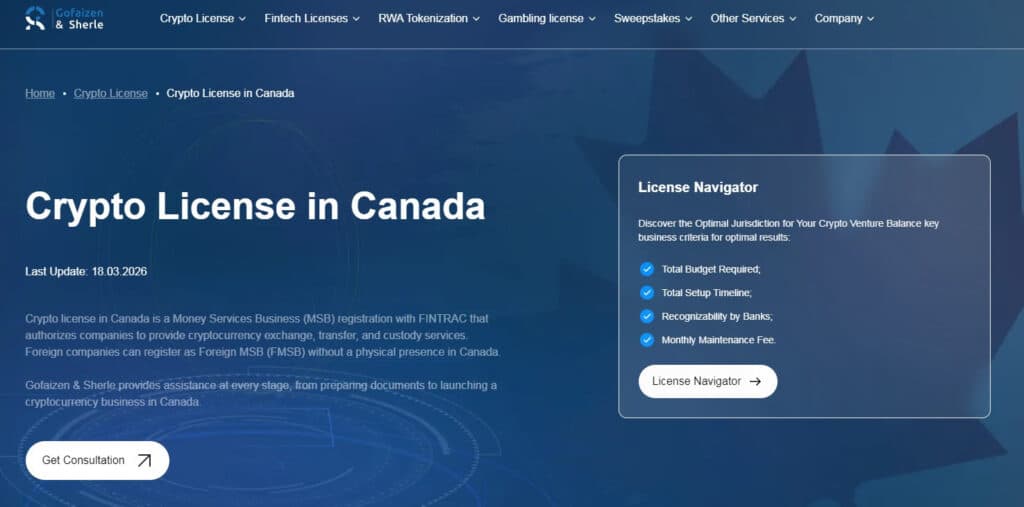
Gofaizen & Sherle, legal consultants for crypto licensing in Canada, has guided licensing projects across more than 50 countries, with its Canada team working alongside colleagues in Europe, Asia, and Latin America. A client who registers in Canada today can expand into the EU next year without switching providers, thanks to their status as a specialized crypto licensing firm with global reach.
What clients get from working with them:
- Three price tiers match different needs. The 9,800 USD package covers application support for existing companies. The 13,000 USD tier adds company formation and a local director. The 15,200 USD option includes corporate account setup with Canadian banks that accept crypto clients.
- The Crypto License Navigator tool compares jurisdictions based on four inputs: total budget, expected timeline, bank accessibility, and monthly maintenance costs. Gofaizen & Sherle experts recommend running a business model through the tool before filing any application.
- Trustpilot reviews cite specific outcomes. One client noted “responsiveness, attention to detail, and ability to navigate intricate legal challenges.” Another highlighted after-sales support, saying the team set up a dedicated follow-up group and handled post-license queries with “incredible speed.”
- Dual regulatory work comes standard. FINTRAC covers AML. CSA covers securities. The firm runs both applications in parallel when token offerings trigger securities rules.
What past clients say: The team does not disappear after approval. One client mentioned the follow-up group stayed active for months, answering questions about ongoing compliance and regulatory updates.
2. Stalirov & Co
Stalirov & Co built their practice around the US and Canadian markets. Their website mentions FINTRAC, CSA, and IIROC regulations by name. They have done Canada-specific regulatory work for clients, offering a trusted legal service to obtain a crypto license for businesses on both sides of the border.
The firm provided legal support for Intellabridge, a Colorado-based fintech company trading on the Canadian Securities Exchange. Their team prepared legal opinions covering FINTRAC, CSA, and IIROC requirements for that engagement.
What clients get from working with them:
- One team handles both US MSB registration with FinCEN and Canada MSB registration with FINTRAC. Clients operating on both sides of the border do not need to coordinate between separate firms. Their legal crypto consulting covers the full North American regulatory landscape.
- Compliance officer packages include documentation of reporting lines. FINTRAC asks who the compliance officer reports to and whether that person has budget authority. Stalirov & Co documents those relationships clearly in the application.
- A regulatory alert system covers both countries. When FINTRAC updates guidance or CSA issues new notices, clients get summaries with action items. No digging through regulator websites.
- Their Princeton, New Jersey office puts them within driving distance of US regulators while maintaining Canada capability through remote work and partner relationships.
What past clients say: The Intellabridge engagement involved legal opinions for four regions, including Canada. The firm structured integration with US crypto custodians, German banks, and Canadian regulators under one umbrella.
3. Manimama
Manimama built their practice around one type of client. Crypto companies. Their focus stays on exchanges, wallet providers, token projects, and the compliance work those businesses require. No side work in forex or gambling or traditional payment processing. Just crypto from start to finish. Their team serves as legal consultants for crypto licensing with a sharp focus on Canada.
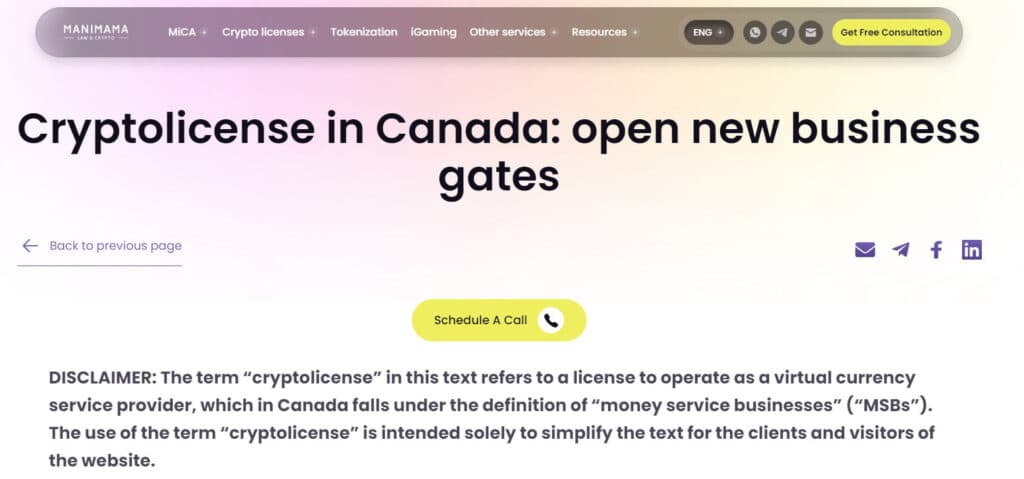
Their website lists Canada among their licensing jurisdictions. They also place Canada in the “fastest registration” category, which tells you they have clocked the timeline more than once.
What their Canada work looks like in practice:
- Their jurisdiction breakdown highlights Canada as a spot with no capital requirements. FINTRAC does not ask for minimum share capital. That makes Canada different from EU jurisdictions, where you need 50,000 to 150,000 EUR just to apply.
- Their team has handled the securities side for token projects. CSA oversight applies when tokens look like investment contracts. Manimama’s experience with both FINTRAC and CSA means they know when to file one application versus two.
- Their all-inclusive packages mean one fee covers everything from jurisdiction selection to policy drafting to regulator follow-ups. Clients do not get surprise invoices for extra calls or document reviews.
- They schedule compliance reviews six months out from approval. FINTRAC often reaches back with questions about how policies are working in practice. Manimama makes sure clients have documented answers ready before the regulator asks, which is what experienced lawyers for obtaining crypto license do.
What past clients say: The firm positions itself as a partner for the full lifecycle, not just the application window. Their all-inclusive model means clients pay one fee for everything from jurisdiction selection to post-license reviews.
4. Samson Solutions
The ChaosOTC testimonial on their website is worth paying attention to. Denys, the client, did not just leave a vague review. He named his company and specified what Samson Solutions helped with: MSB registration in Canada.
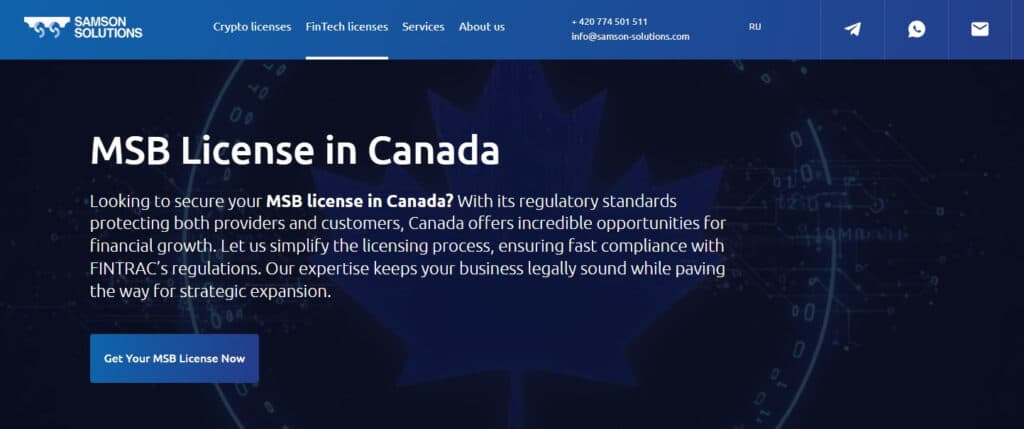
That level of public acknowledgment matters because most crypto licensing work happens behind closed doors. Clients rarely go on record thanking their legal team by name. Denys did. Samson Solutions operates as a specialized legal firm for obtaining crypto license with verified Canada success.
Where their experience shows up:
- European crypto firms switching to Canada face a choice: find a new firm or stick with the one that already knows their business. Samson Solutions built their practice on EU licensing. The MiCA framework and Canada’s FINTRAC system share similar AML bones. Clients do not start from zero.
- The Travel Rule works differently in each country. Samson Solutions has implemented it for clients under MiCA. Adapting that work to FINTRAC’s 1,000 CAD threshold is a matter of adjusting the numbers, not rebuilding the system.
- FINTRAC reviews compliance officer authority carefully. Samson Solutions has documentation templates that show reporting lines and budget authority in the format Canadian regulators expect.
- Reporting deadlines in Canada differ from EU timelines. Samson Solutions tracks both. Their calendar system already handles cross-border schedules.
What past clients say: The ChaosOTC testimonial mentions that everything went smoothly because of the team’s expertise. The client specifically thanked them for Canada MSB registration help, not just their European work.
5. COREDO
COREDO is based in Prague but their reach extends to North America. Their Canada practice includes MSB registration work documented in guides published on their site. Their crypto lawyers handle everything from jurisdiction selection to final approval.
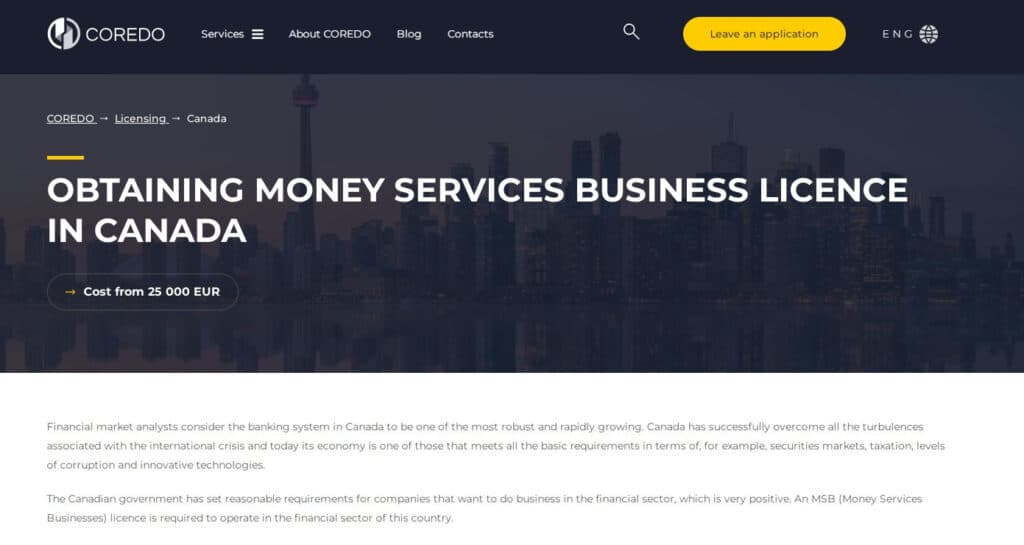
One option they offer is buying an existing licensed company. Their current inventory includes a British Columbia MSB registered in July 2023. The license covers money remittance, virtual currency dealing, currency exchange, and payment service operations. The price is 40,000 EUR. Change of ownership is included.
What their Canada work looks like in practice:
- Before recommending any jurisdiction, they run options through a matrix that scores each on six factors: how the regulatory system works, how long approval takes, whether you need a local office, what the banking situation looks like, tax rates, and whether the jurisdiction carries any reputational baggage.
- Their AML setup goes beyond basic KYC. They implement PEP screening against global watchlists, OFAC and EU sanctions checks, and KYT tools that track transaction patterns and flag suspicious activity with case management.
- Their compliance framework adapts to local requirements while staying aligned with FATF standards. They integrate monitoring tools so clients are not running manual checks.
- Their research on EU regulation for 2026 shows over 60 new directives taking effect across the bloc. EBA data they cite indicates AML violation fines jumped 38 percent in 2025 compared to the prior year. That context matters for clients watching how global enforcement trends might influence Canadian regulators.
What past clients get: Access to ready-made licensed companies bypasses the application process entirely. A British Columbia MSB with full operating permissions can be acquired and transferred to new ownership in weeks rather than months.
How to Spot a Firm That Actually Knows Canada
Canada MSB registration looks simple on paper. The complexity shows up in the details FINTRAC does not publish on their website. Firms that offer genuine legal consulting services for crypto business setup will walk you through those details before you submit anything.
One detail is the timing of compliance officer appointments. FINTRAC wants the officer named before submission, but they also want proof that person has started building the compliance program. A firm that has done this before will have the officer reviewing transaction monitoring logs weeks before the application goes in.
Another detail is the Travel Rule threshold. The rule applies to transfers above 1,000 CAD. But FINTRAC also looks at whether your system flags transactions that fall just under that threshold repeatedly. A pattern of 999 CAD transfers gets flagged. Firms that know Canada will build that logic into your monitoring from the start.
Bank introductions follow a pattern too. The big Canadian banks have internal crypto policies that change quarterly. A firm that stays current will know which bank is accepting new MSB clients this month, not which bank accepted them last year.
Ask firms about their last rejection. Every firm has had applications delayed or returned. The ones worth hiring will tell you what went wrong and how they fixed it. The ones who say they have never had a rejection either have not done enough applications or are not being honest. FINTRAC publishes rejection data. The numbers do not lie.
Final Thoughts
Canada offers a clear path to crypto licensing. No minimum capital. Foreign companies welcome. A framework that has operated since 2014. Banks that recognize FINTRAC registration.
The five firms here have all done Canada MSB work multiple times. Some have done it dozens of times. They know FINTRAC’s review patterns. They know which business models raise questions. They know what documentation gets approved on the first submission.
One question separates the firms worth hiring from the ones worth skipping. Ask them about a client who got their license three years ago. If they can tell you what compliance challenges that client faced last quarter, they are still involved. If they cannot remember the client, they moved on after the approval.
The firms that stay involved keep their clients licensed. They know when FINTRAC updates Travel Rule guidance. They know when CSA issues new notices. They know which banks have started accepting crypto clients.
Pick a firm that treats the license as the beginning. FINTRAC treats it that way too.